
Teen Patti, meaning “three cards” in Hindi, is India’s most beloved card game. Played during festivals, family gatherings, and friendly get-togethers, this game has captured the hearts of millions across the subcontinent. Often compared to poker, Teen Patti has its own distinct charm, simpler rules, and a unique ranking system that every player must understand.
Whether you are sitting at a physical table with friends or exploring the digital version on a trusted platform like Gold 365 , knowing the Teen Patti hand rankings is the foundation of your strategy. A player who understands exactly where their hand stands—from an unbeatable Trail to a weak High Card—has a significant edge over someone playing blindly. The Gold 365 homepage offers a comprehensive introduction to various card games, secure payment options, and a user-friendly interface designed for both beginners and experienced players.
In this comprehensive guide, we will explain every Teen Patti hand ranking order, from the strongest to the weakest, with clear examples, tie-breaking rules, and practical tips. By the end, you will confidently assess your Teen Patti hands and make smarter betting decisions.
Understanding Card Values in Teen Patti
Before diving into the rankings, let’s establish the basic card hierarchy. Teen Patti uses a standard 52-card deck without jokers. Cards are ranked as follows:
Ace (A) > King (K) > Queen (Q) > Jack (J) > 10 > 9 > 8 > 7 > 6 > 5 > 4 > 3 > 2
Key Points to Remember:
- Aces are always high. There is no “low Ace” concept in Teen Patti.
- Suits (Spades, Hearts, Diamonds, Clubs) are equal in value. They only matter for Pure Sequence and Color hands.
- 2-A-K is NOT a valid sequence in Teen Patti.
Now, let’s explore the six Teen Patti combinations in the correct ranking order.
Complete Teen Patti Hand Rankings (Highest to Lowest)
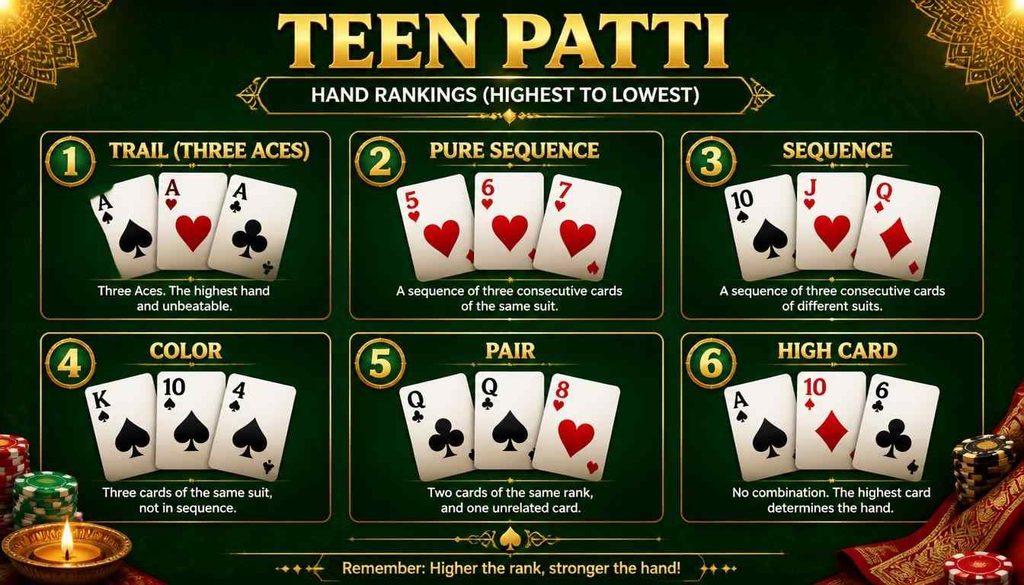
| Rank | Hand Name | Description | Example |
|---|---|---|---|
| 1 | Trail (Three of a Kind) | Three cards of the same rank | A♠ A♥ A♦ |
| 2 | Pure Sequence (Straight Flush) | Three consecutive cards, same suit | 5♥ 6♥ 7♥ |
| 3 | Sequence (Straight) | Three consecutive cards, mixed suits | 10♠ J♥ Q♦ |
| 4 | Color (Flush) | Three cards same suit, not in sequence | K♠ 10♠ 4♠ |
| 5 | Pair (Double) | Two cards of the same rank + kicker | Q♣ Q♠ 8♥ |
| 6 | High Card | No combination—highest card wins | A♠ 10♦ 6♣ |
Now, let’s examine each hand in detail.
1. Trail (Three of a Kind / Set / Trio)
What is a Trail?
A Trail is the strongest possible hand in Teen Patti. It consists of three cards of the exact same rank. This hand is extremely rare and almost guarantees victory.
Ranking Within Trails:
When comparing two Trail hands, the higher-ranked three-of-a-kind wins:
- A-A-A – Highest Trail (best hand in the game)
- K-K-K
- Q-Q-Q
- J-J-J
- 10-10-10
- 9-9-9
- 8-8-8
- 7-7-7
- 6-6-6
- 5-5-5
- 4-4-4
- 3-3-3
- 2-2-2 – Lowest Trail
Example:
You are dealt 7♠, 7♥, 7♦. This is a Trail of 7s. Unless an opponent holds 8-8-8 or higher, you will win this hand. With a Trail, you can bet aggressively to maximize your winnings.
Why It Ranks Highest:
A Trail is statistically the rarest hand in Teen Patti. There are only 52 possible Trail combinations out of 22,100 total hands (approximately 1 in 425 hands). Its rarity makes it the ultimate winning hand.
Comparison with Pure Sequence:
A Trail beats any Pure Sequence, even the highest one (A-2-3 of the same suit). If you have a Trail, only a higher Trail can defeat you.
2. Pure Sequence (Straight Flush / Pakki Round)
What is a Pure Sequence?
A Pure Sequence is the second-highest hand. It consists of three consecutive cards that all belong to the same suit. In poker terms, this is a Straight Flush. It’s also called “Pakki Round” (pure run) in Hindi.
Ranking Within Pure Sequences:
The ranking order is unique in Teen Patti:
- A-2-3 (same suit) – Highest Pure Sequence
- A-K-Q (same suit)
- K-Q-J (same suit)
- Q-J-10 (same suit)
- J-10-9 (same suit)
- 10-9-8 (same suit)
- 9-8-7 (same suit)
- 8-7-6 (same suit)
- 7-6-5 (same suit)
- 6-5-4 (same suit)
- 5-4-3 (same suit)
- 4-3-2 (same suit) – Lowest Pure Sequence
Important: A-2-3 is the highest Pure Sequence, NOT A-K-Q. This is a key rule that differs from poker.
Example:
You hold 5♥, 6♥, 7♥. This is a Pure Sequence because the cards are consecutive (5-6-7) and all hearts. This hand beats any regular Sequence, Color, Pair, or High Card.
Why It Ranks Here:
A Pure Sequence is almost as rare as a Trail. There are only 48 possible Pure Sequence combinations (about 1 in 460 hands). It outranks all lower hands because of its combination of consecutive ranks and matching suits.
Comparison with Sequence:
A Pure Sequence beats a regular Sequence because of the additional suit requirement. For example, 5♥-6♥-7♥ beats 5♠-6♦-7♣ every time.
3. Sequence (Normal Run / Straight)
What is a Sequence?
A Sequence consists of three consecutive cards that are NOT all from the same suit. This hand is weaker than a Pure Sequence but stronger than a Color, Pair, or High Card.
Ranking Within Sequences:
The ranking follows the same order as Pure Sequences:
- A-2-3 (mixed suits) – Highest Sequence
- A-K-Q (mixed suits)
- K-Q-J (mixed suits)
- Q-J-10 (mixed suits)
- J-10-9 (mixed suits)
- 10-9-8 (mixed suits)
- 9-8-7 (mixed suits)
- 8-7-6 (mixed suits)
- 7-6-5 (mixed suits)
- 6-5-4 (mixed suits)
- 5-4-3 (mixed suits)
- 4-3-2 (mixed suits) – Lowest Sequence
Example:
You are dealt 10♠, J♥, Q♦. These are consecutive cards (10-J-Q) but from different suits. This is a Sequence, not a Pure Sequence.
Why It Ranks Here:
A Sequence requires consecutive ranks but lacks the suit requirement of a Pure Sequence. Since it’s easier to achieve, it ranks lower. However, it still requires three cards in numerical order, making it stronger than any Color, Pair, or High Card.
Important Rule:
2-A-K is NOT a valid sequence in Teen Patti. This combination is not recognized in either Pure Sequence or Sequence hands.
Comparison with Color:
Any Sequence beats any Color because the consecutive order requirement is more difficult to achieve than simply matching suits. For example, 4♠-3♦-2♣ beats A♠-K♠-J♠.
4. Color (Flush)
What is a Color?
A Color (Flush) is a hand where all three cards belong to the same suit but are NOT in consecutive order. This hand ranks below both Sequence types but above Pairs and High Cards.
Ranking Within Colors:
When comparing two Color hands, the highest card is compared first. If equal, the second-highest card is compared, and then the third.
- Best Color: A-K-J (same suit)
- Second Best: A-K-10 (same suit)
- Third Best: A-K-9 (same suit)
- Worst Color: 5-3-2 (same suit)
Example:
You are dealt K♠, 10♠, 4♠. All three cards are spades, but they are not consecutive (K-10-4). This is a Color hand.
Tie-Breaking Example:
Player 1 has A♠, K♠, 9♠. Player 2 has A♣, K♣, 8♣. Both have Ace-King Color. Compare the third card: 9 beats 8, so Player 1 wins.
Why It Ranks Here:
A Color requires all three cards to match in suit but does not require consecutive ranks. This makes it more common than a Sequence but still a solid hand. It outranks a Pair because three matching suits are statistically rarer than two matching ranks.
Comparison with Pair:
Any Color beats any Pair. For example, A♠-K♠-J♠ (Color) beats A♣-A♦-K♥ (Pair of Aces). The suit requirement across all three cards makes it a stronger combination.
5. Pair (Double)
What is a Pair?
A Pair (Double) contains exactly two cards of the same rank, with the third card (called the “kicker”) being different. This is one of the most common Teen Patti hands and ranks just above a High Card.
Ranking Within Pairs:
- Higher-ranked pair wins.
- If pairs are equal, the higher kicker wins.
- Best Pair: A-A-K (Pair of Aces with King kicker)
- Second Best: A-A-Q
- Third Best: A-A-J
- Worst Pair: 2-2-3 (Pair of 2s with 3 kicker)
Example:
You are dealt Q♣, Q♠, 8♥. This is a Pair of Queens with an 8 kicker. Opponent has Q♦, Q♥, 9♣. Both have Queens, but their 9 kicker beats your 8, so they win.
Why It Ranks Here:
A Pair is easier to achieve than a Color, making it a lower-ranking hand. However, having two matching cards gives it a clear advantage over a High Card hand, where no cards match.
Comparison with High Card:
Any Pair beats any High Card. For example, 2♠-2♥-A♦ (Pair) beats A♠-K♦-Q♣ (High Card). The presence of a matching pair outweighs even the highest individual cards.
6. High Card
What is a High Card?
A High Card hand is the weakest Teen Patti combination. It occurs when none of the above hands are formed—no Trail, no Pure Sequence, no Sequence, no Color, and no Pair. The winner is determined by the highest card, then the second-highest, then the third.
Ranking Within High Cards:
Compare the highest card first, then the second-highest, then the third.
- Best High Card: A-K-J (mixed suits, no pair, no sequence)
- Second Best: A-K-10
- Third Best: A-K-9
- Worst High Card: 5-3-2 (mixed suits)
Example:
You hold A♠, 10♦, 6♣. This is a High Card hand with Ace as your highest card. It beats any High Card without an Ace. If both have Ace-high, compare the second card.
Tie-Breaking Example:
Your hand: A♠, 10♦, 6♣. Opponent: A♥, 9♠, 7♦. Both have Ace-high. Compare second cards: 10 beats 9, so you win.
Why It Ranks Lowest:
A High Card hand has no matching ranks, no consecutive cards, and no matching suits. It is the most common and weakest hand in Teen Patti.
How to Compare Similar Hands
Understanding Teen Patti card rankings includes knowing how to break ties when players have the same hand type:
| Hand Type | Comparison Method |
|---|---|
| Trail | Higher three-of-a-kind wins |
| Pure Sequence | Higher sequence wins (A-2-3 highest) |
| Sequence | Higher sequence wins (A-2-3 highest) |
| Color | Compare highest card, then second, then third |
| Pair | Higher pair wins; if equal, higher kicker wins |
| High Card | Compare highest card, then second, then third |
Common Beginner Mistakes
1. Overvaluing a Pair
Many beginners think any Pair is a strong hand. In reality, a low Pair can be beaten by a Color, Sequence, Pure Sequence, or Trail. Play cautiously with low pairs.
2. Misunderstanding A-2-3
New players often assume A-K-Q is the highest sequence. Remember: A-2-3 is the highest in Teen Patti, not A-K-Q.
3. Forgetting Suit Differences
A Color and a Pure Sequence are different. If your cards are consecutive AND same suit, you have a Pure Sequence—much stronger than a regular Color.
4. Ignoring Kickers
In Pair and High Card hands, the kicker (or second and third cards) often decides the winner. Always compare all three cards.
5. Playing Too Many Hands
Patience is key. Don’t play every hand—fold more often than you play, especially with High Card or low Pair hands.
Simple Tips for Remembering the Ranking Order
Use this memory trick: “Trail, Pure, Sequence, Color, Pair, High”
- Trail – Three of a kind
- Pure Sequence – Consecutive + same suit
- Sequence – Consecutive + mixed suits
- Color – Same suit only
- Pair – Two matching
- High Card – No combination
Or remember: “T-P-S-C-P-H” (Think: “Top Players See Cards Properly Handled”)
Comparison Table: Teen Patti Hand Rankings
| Rank | Hand | Description | Best Example | Worst Example |
|---|---|---|---|---|
| 1 | Trail | Three same rank | A♠ A♥ A♦ | 2♣ 2♦ 2♥ |
| 2 | Pure Sequence | 3 consecutive, same suit | A♠ 2♠ 3♠ | 4♥ 3♥ 2♥ |
| 3 | Sequence | 3 consecutive, mixed suits | A♣ 2♦ 3♥ | 4♠ 3♦ 2♣ |
| 4 | Color | 3 same suit, not consecutive | A♠ K♠ J♠ | 5♥ 3♥ 2♥ |
| 5 | Pair | 2 same rank + kicker | A♣ A♦ K♥ | 2♠ 2♥ 3♦ |
| 6 | High Card | No combination | A♠ K♦ J♣ | 5♣ 3♦ 2♥ |
Advanced Strategy Tips
1. Know When to Fold
A High Card or low Pair is usually a fold, especially if there’s been a raise. Don’t chase unlikely wins.
2. Read Opponents
Watch for betting patterns. A sudden large raise may indicate a Trail or Pure Sequence. Adjust your play accordingly.
3. Bluff Sparingly
Bluffing is part of Teen Patti, but use it wisely. Bluff when you have a decent High Card to represent a stronger hand, but don’t overdo it.
4. Manage Your Bankroll
Set a budget before you start playing and stick to it. Whether you’re playing offline or online, responsible gaming is essential. Always practice responsible gaming to ensure a safe and enjoyable experience.
5. Use Position to Your Advantage
Later positions allow you to see how others bet before deciding. Use this information to make smarter choices.
Playing Teen Patti and Other Games Online
If you enjoy Teen Patti, you can now play it online from the comfort of your home. Many platforms offer the game along with exciting features like tournaments, bonuses, and live dealers.
Gold 365 provides a seamless gaming experience with multiple variations of Teen Patti and other card games. Visit the homepage to explore the full range of options available, including classic Teen Patti, variations like Muflis and AK47, and much more. The platform is designed to offer a secure and fair gaming environment for all players. To get started, simply register on Gold 365 and create your account in minutes.
For sports enthusiasts, the platform also offers comprehensive Cricket betting options with competitive odds on major tournaments and matches worldwide, including IPL, T20 World Cup, bilateral series, and international test matches. You can place bets on match winners, top batsmen, top bowlers, man of the match, and various in-play markets. Cricket fans can enjoy live updates and dynamic odds throughout the game.
If you prefer the thrill of real-time action with live dealers, the live casino betting section brings the authentic casino experience directly to your screen with games like Roulette, Blackjack, Andar Bahar, Baccarat, and Teen Patti live. Interact with professional dealers, enjoy high-definition streaming, and experience the excitement of a real casino from the comfort of your home. Once you’re ready, you can log in to Gold 365 and access all these exciting games instantly.
New players and loyal customers can take advantage of exclusive Bonus and offers that provide extra value, welcome bonuses, free bets, reload bonuses, cashback opportunities, and special festival promotions to boost your bankroll and extend your playing time. These offers are updated regularly, so be sure to check back often for the latest deals.
For any queries regarding account setup, game rules, deposits, withdrawals, or technical assistance, the dedicated contact us page is available 24/7 with responsive customer support. The team is always ready to assist you with any questions or concerns you may have. Whether you need help with a transaction or have a question about a game, support is just a click away.
Frequently Asked Questions (FAQ)
Q1: What is the highest Teen Patti hand ranking?
A: The highest Teen Patti hand ranking is a Trail (Three of a Kind), specifically A-A-A (Three Aces). This is the best possible Teen Patti winning hand.
Q2: Does 2-A-K count as a Sequence?
A: No. 2-A-K is NOT a valid sequence in Teen Patti. The only valid sequences involving an Ace are A-2-3 and A-K-Q.
Q3: Is A-2-3 higher than A-K-Q?
A: Yes. In Teen Patti, A-2-3 is the highest sequence, above A-K-Q. This is a unique rule that differs from many other card games.
Q4: Which hand beats a Color?
A: A Trail, Pure Sequence, or Sequence all beat a Color. A Color beats a Pair or High Card.
Q5: How do I compare two Pair hands?
A: First, compare the pair rank. Higher pair wins. If equal, compare the kicker (the third card). Higher kicker wins.
Q6: How rare is a Trail?
A: A Trail occurs in approximately 1 in 425 hands. It is the rarest Teen Patti combination.
Q7: What if two players have the exact same hand?
A: If both players have identical hands (same ranks, same suits), the pot is split.
Q8: Can I play Teen Patti online?
A: Yes. Many trusted platforms like Gold 365 offer Teen Patti online with secure payments and fair gameplay. Simply log in to Gold 365 to start playing.
Q9: What is the difference between a Pure Sequence and a Sequence?
A: A Pure Sequence requires three consecutive cards of the same suit. A Sequence requires three consecutive cards but allows mixed suits. A Pure Sequence is stronger.
Q10: Which hand wins between a Color and a Pair?
A: A Color beats a Pair. For example, A♠-K♠-J♠ (Color) beats A♣-A♦-K♥ (Pair of Aces).
Other Sites for more details silverech